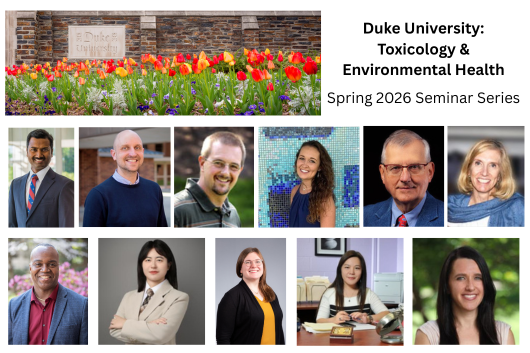

Pharm 848-S/ENV 848-S
Thursdays 12:00-1:15pm Eastern Time | Free and open to the public
Location: Field Auditorium* room 1112, Grainger Hall, Duke University Nicholas School of the Environment
*unless otherwise noted
Virtual Attendance: Most seminars will be streamed on Panopto. Click on each seminar’s link to access that day’s livestream!
Spring 2026 Seminar Series – Integrated Toxicology & Environmental Health Program
Jan 8 Alumni Panel
Invite only; RSVP required.
Jan 15 Satya Achanta, DVM, PhD, DABT; Duke
Modeling Human Chemical Exposures to Accelerate Antidote and Forensic Advancements
Jan 22 Justin Colacino, PhD, MA, MPH; University of Michigan
Epidemiologically informed toxicology to understand chemical exposures and chronic disease inequities
Jan 29 Scott Auerbach, PhD, DABT; NIH/NIEHS
Adventures in evolving toxicology testing: Omics, HTS, AI and whatever comes next
Feb 5 Emily Green, PhD candidate; Duke
Host–Microbiome Interactions as Modulators of Embryogenesis and Developmental Toxicity in Teleost Fish: Implications for Evolved Chemical Resistance
Feb 12 Randy Jirtle, PhD; NC State University
Epigenetics: The Science of Hope
Feb 19 Kari C. Nadeau, MD, PhD; Harvard T.H. Chan School of Public Health
Exposomics as a Tool for Prevention and Therapy
Feb 26 Antonio Baines, PhD; North Carolina Central University
TBD
Mar 5 Liyin He, PhD; Duke
TBD
Mar 12 No Seminar – Spring Break
Mar 19 Rebecca Hoehn, PhD candidate, Duke
TBD
Mar 26 No Seminar – SOT Conference
Apr 2 Lina Mu, PhD, MD; University at Buffalo
TBD
Apr 9 Beverly deSouza, PhD candidate, Duke University
TBD
May 5 Spring Symposium: NAMs and TAMs (Traditional Approaches and Methodologies): The Future of Laboratory-Based Environmental Health and Toxicology Research for Harm Reduction
This seminar series is supported in part by the National Institute Of Environmental Health Sciences of the National Institutes of Health under the Duke University Superfund Research Program (award P42ES010356) and the Duke University Program in Environmental Health (award T32ES021432). Seminar content is solely the responsibility of the speakers and does not necessarily represent the official views of the National Institutes of Health.