
By Katie Maxfield, DUSRC Community Engagement Core (CEC) Intern
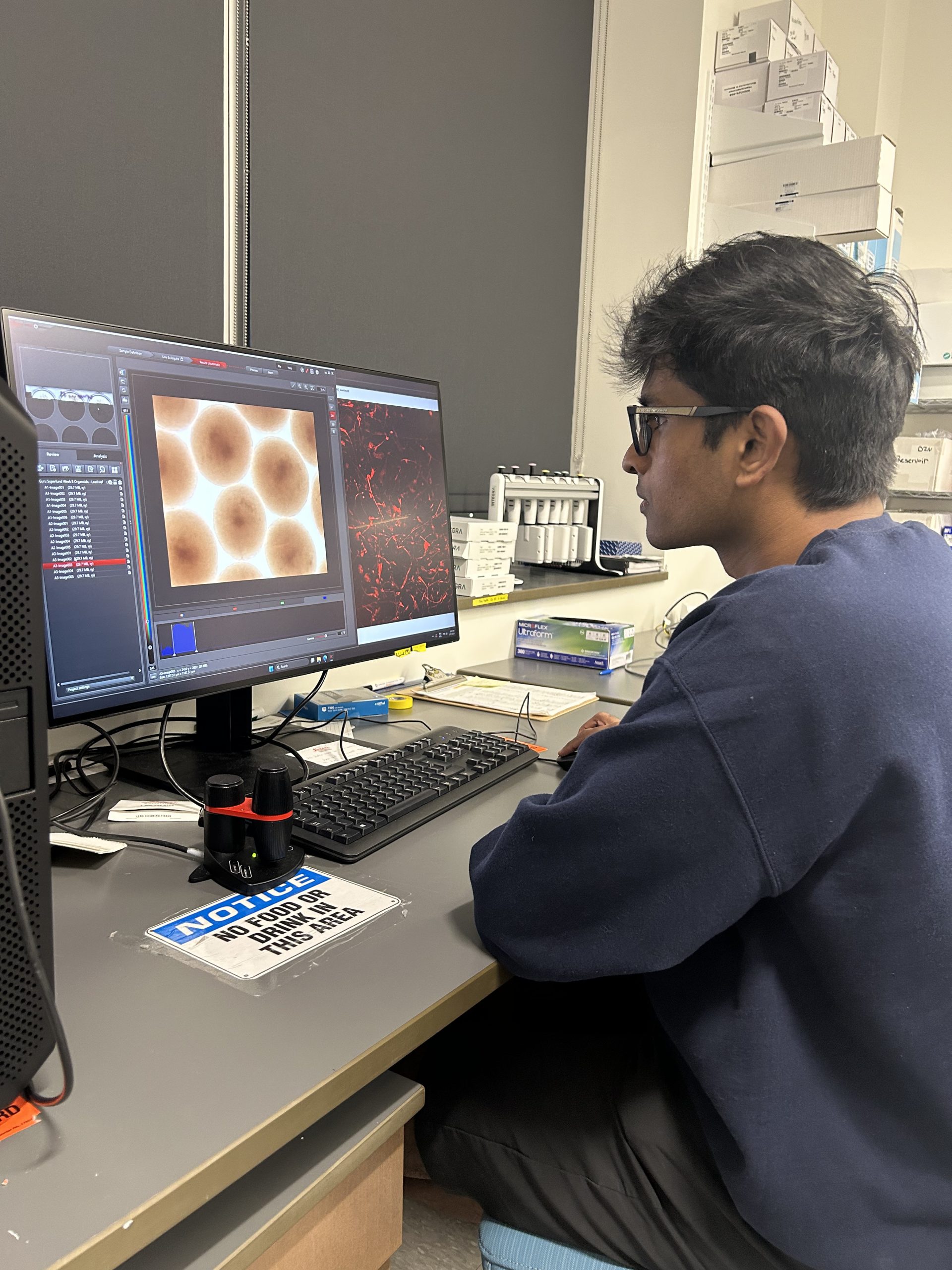
Guru Ulaganathan, Superfund Trainee and PhD student (Project 3 – Dr. Susan Murphy) was often sick as a kid. He and his family moved around a lot: from Houston to Kuala Lumpur to Chennai. He seemed to fall ill with something once a month or so, but his sister never really got sick, despite growing up in the same environment. Guru wondered what made him more susceptible to his surroundings. Pondering this issue eventually led him to the study of environmental health and toxicology, which he felt was “instinctive” after his childhood experiences. During our conversation, he noted to me that “one small early exposure that you’re not responsible for can really shape your life’s trajectory.”
He made his way to the University of California, Los Angeles (UCLA), where he switched majors (his initially application was for Aerospace Engineering) and earned his B.S. in Microbiology, Immunology, and Molecular Genetics. There, he learned about Dr. Patrick Allard’s work with the nematode C. elegans and their use in studying chemicals and plastics such as ethanol and BPA. In the Allard lab, he worked with an assay called “Green Eggs and HIM” (High Incidence of Males) that helped identify chemical reprotoxicants using the worms. He also dabbled in some cannabinoid work at UCLA, which is how he first came across the work of Dr. Susan Murphy.
When it came time to choose mentors for his PhD, he realized that Dr. Murphy was at the top of his list. What followed was a Zoom meeting with her that ran long past its scheduled time, during which they discussed her work and research, and it was through this that he first heard about the Duke University Superfund Research Center (DUSRC). Guru described many of his subsequent meetings with Dr. Murphy in this way: they both liked to talk and share ideas. He appreciates that Dr. Murphy often has her door open (literally) and is readily available to discuss the direction of their research. Much of his success at Duke he credits to her mentorship
His current research for DUSRC focuses on understanding how exposures to lead, cadmium, and polycyclic aromatic hydrocarbons (PAHs) can affect the developing brain. Through Superfund Project 3, his lab uses human cells, called induced pluripotent stem cells (iPSCs), to generate brain organoids (Brain Spheres) which are then exposed to chemicals to better understand their effects on early neurodevelopment. It’s incorporation as a model for DUSRC is new, which Guru pitched to Dr. Murphy and Dr. Joel Meyer. Following meetings with researchers at Johns Hopkins University (who developed the model), the use of Brain Spheres at DUSRC came to fruition. Using this model, they’re looking at whether a cell’s trajectory can be changed by these early exposures and if so, what the resulting consequences may be. When we spoke, they had just begun the long-term exposures in the lab and are currently in the process of collecting results.
Guru connected his work to current issues in Durham which DUSRC’s Community Engagement Core is also engaged in. Lead contamination from historical waste incinerators has been found in Durham city parks, leading to a wave of park closures and a long timeline for remediation. Lead and cadmium levels often go hand-in-hand, he noted, and some of his lab work is dedicated to understanding their effects on neurodevelopment.
Guru’s day-to-day in the lab varies depending on how many projects he’s working on. Some days are filled with experiments and data analysis, while others are more focused on reading and writing. He is also aware that the flexibility and loose schedule of a PhD can occasionally lead him to work at odd hours of the day, even on the weekends. Thus, he appreciates a good vacation and the way it can reignite his excitement for his research. “You come back feeling like you can and want to do so much,” he noticed.
His favorite part of his work is getting to talk to people and hear new ideas about science. Scientists are often working on the same subject but approaching it from differing points of view. He loves going to symposiums and conferences for this reason: here he can meet folks engaged in similar work, but who might be working in government or industry, and can offer alternative perspectives. Similarly, people who are working on adjacent topics can bring new ideas to his work. “You leave these conversations feeling like, ‘why haven’t I thought about that?’ and then you go home and you read about it,” Guru said. Those conversations might affect the direction of his research or how he contextualizes it going forward. In the future, Guru wants to work to bring people from all backgrounds together to address pressing societal issues pertaining to environmental and global health. He wants to increase awareness of environmental toxicology because, given its nexus with issues such as rising temperatures and air pollution, people are set experience greater and worsening exposures to contaminants in the future.
My favorite thing about discussing Guru’s work with him was seeing how excited he is to talk about science and his approach to it. He made it clear that he believed the act of doing science was to learn, explore, and have your ideas challenged and your mind changed. “It’s always about challenging your beliefs, admitting that you were wrong…” he emphasized. Guru’s curiosity in his research also extends to excitement about books, learning, and life in general. He’s an avid reader, and our conversation got sidetracked recommending books to each other for a while…
Guru was very thoughtful in explaining his complex work to someone who knows very little about the subject. He remarked that scientists have historically not been skilled at communicating their findings without jargon or academic language. He feels that a focus on communication and research translation is usually missing from scientific research today. Thus, he’s excited about some of the upcoming programming that Duke is doing, encouraging researchers to communicate their work to a broader audience, like the Duke Science and Society Periodic Tables event, an informal gathering where scientists discuss their work with the general public. He also hopes to take part in the upcoming Duke Research Café series, which bills itself as “research explained in a way that everyone can understand.”