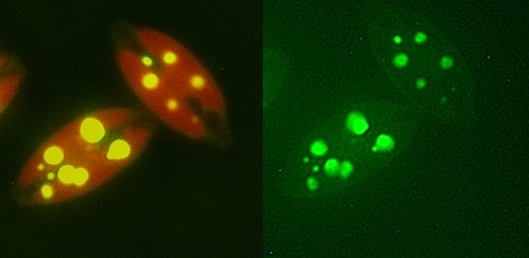

In the open ocean genetically diverse clades of the unicellular cyanobacteria Prochlorococcus are biogeographically structured along environmental gradients, yet little is known about their in situ activity. To address this gap, here we use the numerically dominant Prochlorococcus clade eHL-II (eMIT9312) as a model organism to develop and apply a method to examine their in situ activity using rRNA content and cell size as metrics of cellular physiology. For two representative isolates (MIT9312 and MIT9215) rRNA cell-1 increases linearly with specific growth rate but is anticorrelated with cell size indicated by flow cytometrically measured side scatter (SSC). Although each strain has a unique relationship between cellular rRNA (or cell size) and growth rate, both strains have the same strong positive correlation between rRNA cell-1 SSC-1 and growth rate. We field test this approach and observe distinct patterns of eHL-II clade specific activity (rRNA cell-1 SSC-1) with depth that are consistent with patterns of photosynthetic rates. This molecular technique provides unique insight into the ecology of Prochlorococcus and could potentially be expanded to include other microbes to unravel the ecological and biogeochemical contributions of genetically distinct marine microbes.