Interview by Julie Furr Youngman, T’87, SOE’94, JD’94
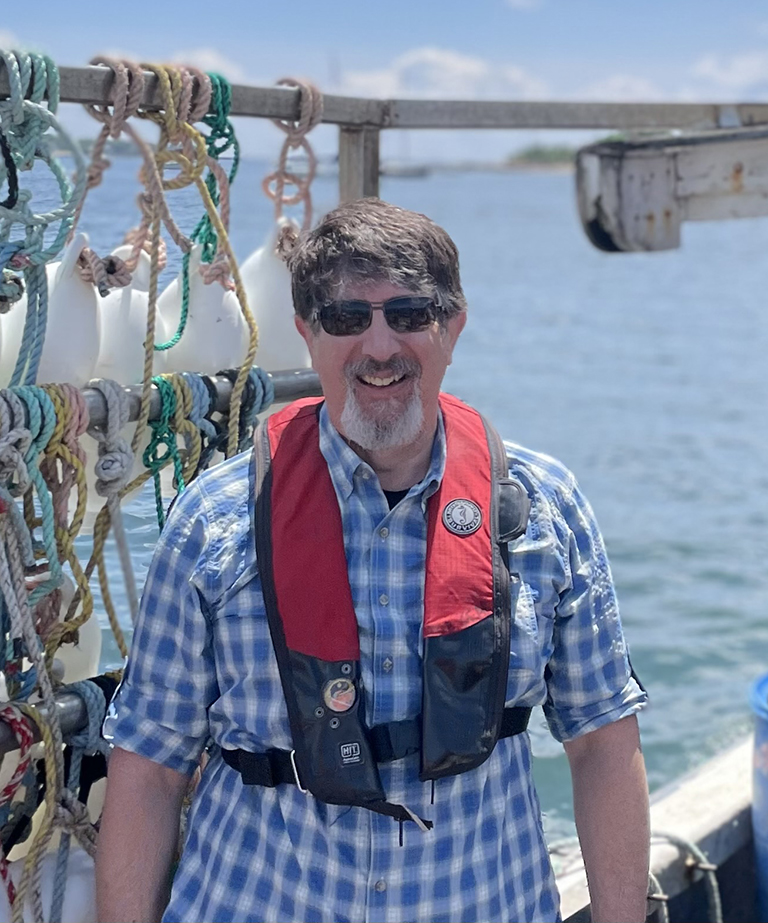
Michael Pentony, MEM’96, has devoted his career to serving the public in myriad ways. After majoring in electrical engineering at Duke, he served as an Air Force officer for six years. He returned to Duke to earn an MEM at the Nicholas School, worked for few years at a regional fishery management council, and has been working at NOAA Fisheries ever since, rising to be the Regional Director for the Greater Atlantic Region. In that capacity, he oversees a large staff responsible for managing commercial and recreational fisheries in federal waters in that entire region, working closely with 21 states. His office also focuses on protecting and recovering endangered species and marine mammals and conserving and protecting the habitat for all fish and marine species.
Tell us a little bit about yourself.
I grew up in a beach town, fishing off the docks, and watching boats unload their fish, so I’ve always had a strong connection to the ocean, plus I love seafood. When I went into the Air Force after college, I worked as a communications satellite engineer, developing systems to support satellite programs. I quickly realized that, while it was interesting, it wasn’t what I wanted to do with the rest of my life. I also felt I was losing my connection with the ocean, though I spent my spare time scuba diving and volunteering with coastal preservation conservation groups.
All that led me back to Duke, where I got my Master of Environmental Management with a focus in coastal environmental management at the Nicholas School. I really honed in on my interests, and managing fisheries, ocean resources, and human interactions with those resources turned out to be something that really motivated me. I felt like I found my niche in a field I was passionate about and could envision a career path. I went to work at the New England Fishery Management Council, where I got my first taste of fisheries management as a public policy-making system, integrating science with the competing interests of the public, commercial fishermen, and recreational fishermen, all within a legal framework and process that was established for the best interests of our country. I found that to be a really interesting, invigorating, and challenging arena to work in.
When did you first realize the work you do could influence the world around you, and how did that moment change you?
When I started working for the New England Fishery Management Council, I was very new to the public policy process. No issue is ever simple, black and white. I’d find myself in a room with scientists and representatives of the public, industry, and conservation groups, who were all very interested in the work we were doing and in the outcome. They would talk about how the way we manage ocean resources directly affects the people who rely on the ocean to make a living, the people who want to enjoy the ocean, recreate on it or in it, and the people who care about protecting the environment. And so, sitting with all of those people, hearing their perspectives, I understood that the implications of the decisions that we make really can affect all those stakeholders differently. I recognized the important of paying attention to everybody’s perspective and the implications of our decisions.
My military and environmental jobs have been very different in terms of going from an engineering field to a public policy field. But they both have involved managing projects and understanding my role within a much larger system.
Michael Pentony
What’s an uncomfortable truth you had to accept about your field or yourself to be able to grow?
Fisheries management, especially within NOAA, is a very complicated field, and so, even though there might be times when my inner engineer feels like the answer to a dilemma is obvious, I can’t jump straight to it. I may think, “Here’s the problem. Here are the facts. Here’s the clear solution. If this was an engineering problem, there would be no debate.” But it’s never just an engineering problem. Maybe it’s also a people problem, or a social science or public policy issue. We have to engage in the process of building consensus and support among varied stakeholders with very different interests and perspectives. And then we have to work through the bureaucracy of a large government agency, which can be time-consuming and cumbersome. Particularly when there’s some urgency to getting a solution in place, it can be frustrating to have to methodically go through all these steps. So that’s my hard truth: recognizing that I have to manage both a system and a process as I work toward the best solution for a problem and then also figure out how to get it implemented in the cleanest, most efficient way possible.
What’s something you’ve had to work hard to become good at and how do you use that in your career?
The hardest thing for me personally was developing emotional intelligence in order to better manage people and their expectations, perspectives, and emotions. Management of fisheries directly affects people’s livelihood, families, and communities, and perceived threats to those values create heightened emotions that can’t be dismissed. Those kinds of issues weren’t really a factor in my engineering and military work. But in my current field, particularly as I’ve grown in different leadership roles, I’ve had to pay much more attention to how I’m perceived by others in terms of understanding and taking into account their needs and perspectives.
How has your military service influenced your approach to environmental work?
My military and environmental jobs have been very different in terms of going from an engineering field to a public policy field. But they both have involved managing projects and understanding my role within a much larger system. During my time in the military, as a junior officer, I managed a small component that was part of a larger satellite system. If my team and I didn’t consider implications to the larger program, we could have been very good at meeting the specifications of our small component but still put the entire system at risk. Appreciating the importance of understanding how everything fits together still serves me well today. The same goes for soft skills like how to communicate to different audiences – in the military I learned how to write for a technical audience while still being able to communicate appropriately up the chain to the non-experts who may not need to be buried in technical details. Those skills have translated well to managing people and systems in the rest of my career.
Are there intersections between national security and environmental sustainability that people should understand?
Yes. One aspect of national security is food security. People love to eat seafood. It’s a healthy protein. There are abundant resources in the ocean. Should our seafood be coming from U.S. waters and U.S. fishermen under U.S. laws? Or should it be imported from Southeast Asia or South America? Securing reliable, sustainable sources of healthy protein and supporting U.S. fishing communities and U.S. industries and reducing dependence on foreign sources promotes national security.
What’s the most critical issue facing marine environments today?
One of the biggest issues we’re facing right now is competition for access to the ocean. Lots of uses compete for space in the ocean – offshore wind energy development, oil exploration, aquaculture, wild harvest fishing, shipping channels, recreational opportunities, fishing opportunities, and so on. Lots of people and lots of interest groups depend on access to the ocean. While our population and those demands grow, the ocean itself is not getting any bigger. So how do we account for those challenges?
And underlying all of that are changes we’re seeing in the ecosystem from climate change. We’re seeing fishery resources move and productivity change – some resources are doing quite well in the face of these environmental changes, but some are not. The Gulf of Maine, which is a big part of my region, had been one of the fastest warming bodies of water in the world. We’re seeing substantial changes in terms of where fishermen are finding fish and what fish they are finding. We’re seeing changes in the migration patterns of North Atlantic right whales. We’re seeing displacement of fishermen from their traditional fishing grounds. Yet our adaptation to those changes is happening slower than the changes themselves, causing frustration on all sides. The combination of ecosystem changes, competition for access to the ocean, competition for resources, and our inability to keep pace with those trends are our biggest challenge right now.
What advice would you have for somebody who wanted to follow in your footsteps?
I would tell students to be prepared and keep their options open if they want to work in fisheries management, in protected resources, or on coastal habitat issues. The most useful MEM concentrations would be coastal and marine systems, of course, and then either environmental analytics and modeling or environmental economics and policy. There is quite a large ecosystem of organizations that are involved in managing ocean resources from the federal agency down to grassroots or local industry. There are lots of opportunities both at the federal and state governments (and at NOAA Fisheries in particular), as well as fishery management councils and commissions, conservation groups, and commercial industry groups. Students can plug into those networks by attending conferences and meetings to build their network. Any opportunity – even a short term contract position – can still help get your foot in the door and known within the network, and then you can look for other opportunities that might be an even better fit and help you take the next steps in your career.