


Ph.D. Graduates
Athena Rycyk
Dissertation Title: Manatee Behavioral Response to Approaching Boats
University Professor, Natural Sciences Collegium, Eckerd College
Email: rycykam@eckerd.edu
Rachel Wilson
Dissertation Title: Using Chemical Tracers to Evaluate Feeding Habits in Coastal Marine Ecosystems: Stable Isotopes and Organic Contaminants
Research Associate, EOAS Oceanography, Florida State University
Email: rachelmywilson@gmail.com
Anna McGregor (Nousek)
Dissertation Title: The Cost of Locomotion in North Atlantic Right Whales Eubalaena glacialis
University Teacher, School of Life Sciences, University of Glascow
Email: Anna.Mcgregor@glasgow.ac.uk
Reny Tyson
Dissertation Title: Fine-Scale Foraging Ecology of Humpback Whales (Megaptera novaeangliae) in the Near-Shore Waters of the Western Antarctic Peninsula
Staff Scientist, Chicago Zoological Society’s Sarasota Dolphin Research Program, Sarasota FL
Email: reny.tyson@duke.edu
Goldie Phillips
Dissertation Title: Passive Acoustics: A Multifaceted Tool for Marine Mammal Conservation
Email: goldie.phillips@duke.edu
Matthew Bowers
Dissertation Title: Behavioral Ecology of the Western Atlantic Short-finned Pilot Whale (Globicephala macrofhynchus)
Postdoctoral Research Scientist, Oregon State University
Joy Stanistreet
Dissertation Title: Ecology of Beaked Whales and Sperm Whales in the Western North Atlantic Ocean: Insights from Passive Acoustic Monitoring
Email: joy.stanistreet@duke.edu
Ashley Blawas
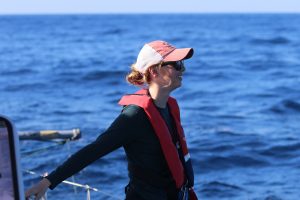 Dissertation Title:
Postdoctoral Research Scientist, Hopkins Marine Station, Stanford University
Jillian Wisse
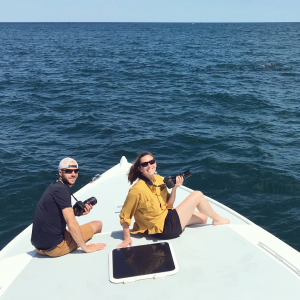 Dissertation Title:
Postdoctoral Research Scientist, Duke University
Amanda Lohmann
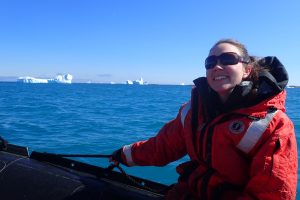
Amanda sails along the western Antarctica peninsula.
Dissertation Title:
Postdoctoral Research Scientist,
Greg Merrill

Dissertation Title: Drivers and Consequences of Plastic Ingestion for Marine Mammals
Greg’s dissertation research broadly focused on assessing the impacts of plastic pollution on marine mammals. Do microplastics translocate into organs around the bodies of whales after ingestion? [Yes] And if so, what are the consequences? His work employs a variety of field and laboratory techniques to apply principles of ecotoxicology to elicit impacts of microplastic exposure on marine mammals, namely utilizing biopsy explants and in vitro cell lines. Greg is also determined sensory explanations that drive plastic consumption, particularly for deep-diving echolocating toothed-whales that are
presumably not utilizing visual ques at depth to hunt. As it were,
plastic marine debris does sound like food to deep-diving
echolocating whales who hunt with sound.
Ph.D. Candidate, University Program in Ecology, Duke University
M.Sc. Biological Sciences 2019, University of Alaska Anchorage
B.S. Biological Sciences 2014, University of California – Davis
gregory.merrill@duke.edu
LinkedIn | Google Scholar