

Ongoing research
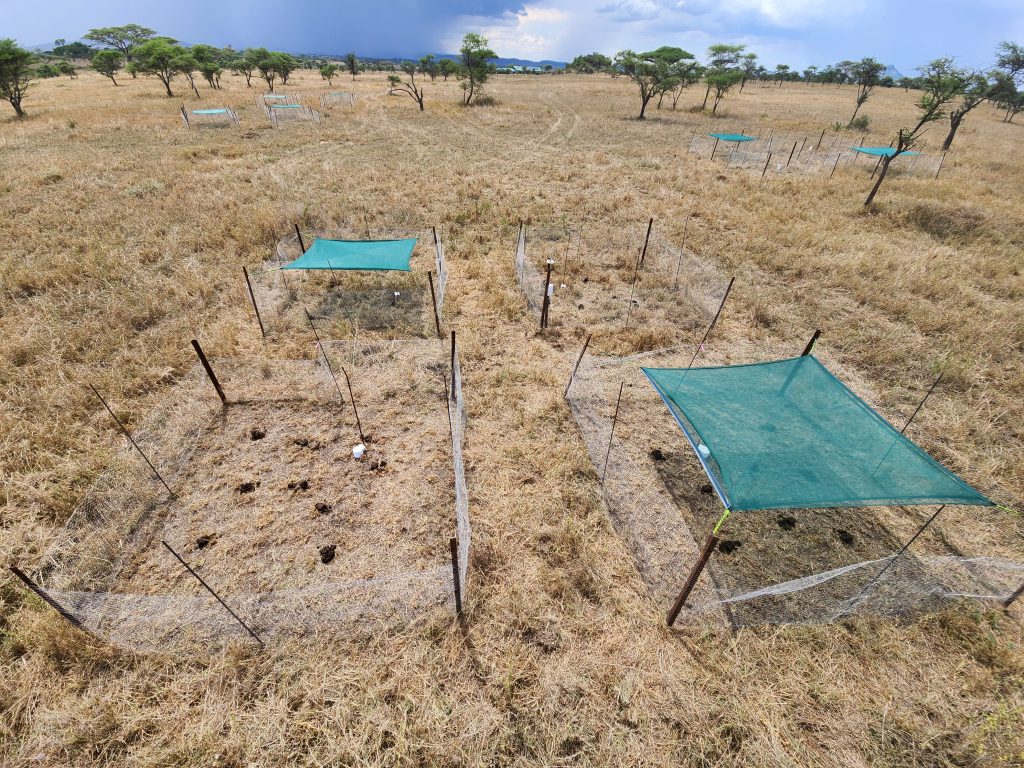
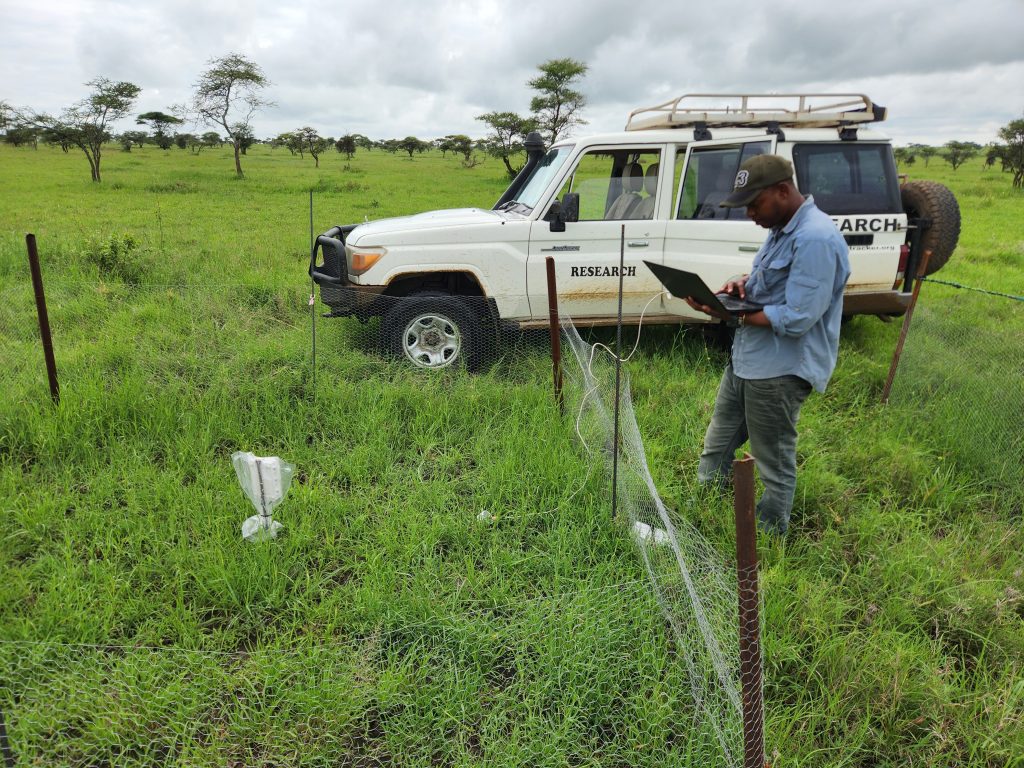
Our work focuses on interactions and feedbacks among species and how these interactions shape ecosystems. We are primarily interested in identifying causal mechanisms and we use an integrated approach that combines field experiments with observational data and modelling to investigate a range of species interactions. Current research priorities include exploring herbivore feeding decisions in response to the risk of predation and disease, how changes in global drivers alter plant-herbivore interactions, the impact of rewilding on vegetation dynamics, and the role of fire and intra-species competition in shaping herbivore communities.
Host-parasite interactions in savanna ecosystems
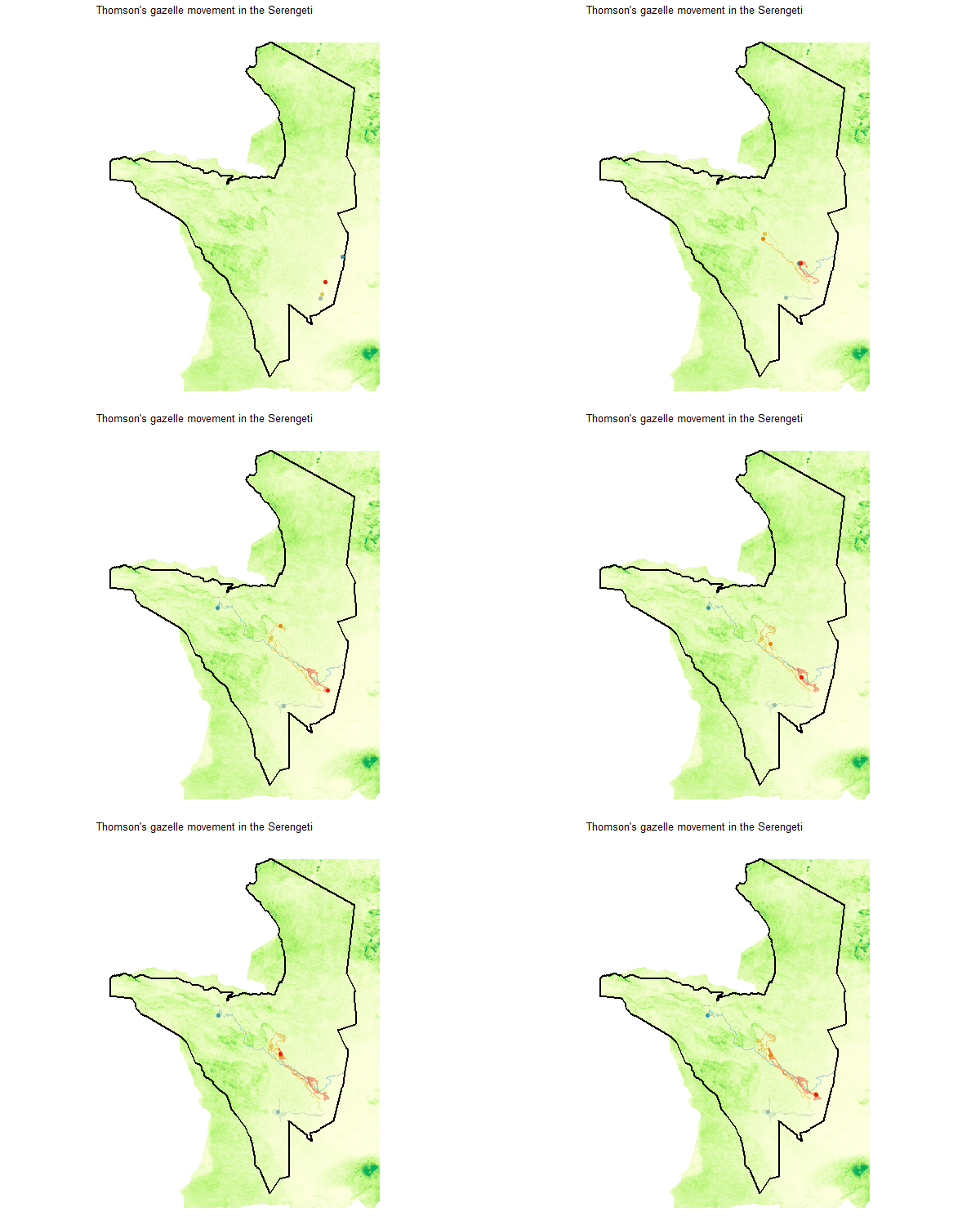
Wild herbivores make movement and feeding decisions based on available resources and the risk of predation and/or infection by pathogens. As a lab, we are exploring how these different drivers of herbivore movement decisions change vegetation and, in turn, feedback to change predation or infection risk. Current work involves tracking migratory Thomson’s gazelle and exploring feedbacks between their feeding decisions, infection by parasites, and risk of predation in the Serengeti National Park, Tanzania.


Exploring top-down vs. bottom-up drivers of vegetation in pocosin peatlands of the eastern US
Current ecological theory posits that plant communities can be filtered by both bottom-up (e.g., nutrient availability) and top-down processes (e.g., herbivory). Within the contiguous U.S., the large-scale defaunation of landscapes has altered top-down effects across all but a few remnant protected areas. Current efforts to rewild degraded ecosystems and restore the historic top-down processes are promising but rewilding practitioners face many challenges. Chief among these are understanding whether restoring locally extinct species is possible in systems that have changed since extirpation, and whether the recovery of apex predators restores functions that were lost after their historic removal. This matters because if ecosystems have changed since defaunation, then rewilding may result in unpredictable or undesirable outcomes that ultimately result in failure to re-establish viable populations of focal species and achieve desired restoration goals.
We’re working on a 5,000 ha drained pocosin peatland to explore how restoration through rewetting and the concurrent reestablishment of an apex predator (red wolves) impact vegetation dynamics and its implications for carbon storage. Pocosin peatlands can store extreme amounts of carbon and were previously home to large stands of white cedar trees. Today white cedars are rare and drained pocosin soils are oxidizing. Our work centers on a series of landscape-scale experiments that will test red wolf-deer-vegetation dynamics in pocosin peatlands being restored to store carbon through rewetting.


What reinforcing feedbacks stabilize tree and grass communities in savanna ecosystems?
Tropical savannas comprise a unique vegetation type: they are neither forests nor grasslands but rather possess characteristics of both. A hallmark of savannas is spatial heterogeneity: they are “unsaturated” in terms of tree cover (i.e., the canopy is discontinuous), and a major reason for this is recruitment limitation (failure of seedlings and saplings to become adult trees). A key challenge is to identify and quantify the pathways and mechanisms that reinforce vegetation heterogeneity, particularly along transitions from grazing lawns to tall fire-prone grasslands, from grassland to savanna, and from savanna to forest. For patterns to be reinforced, feedbacks are required. Our work explores what the dominant feedbacks exist between fire, herbivores, and the vegetation they consume.
Currently we are working on tree neighborhoods in South Africa. In collaboration with Ricardo Holdo (UGA), we have laid out a set of exclosures and tree removal manipulations to test how tree canopies drive biotic feedbacks that reinforce tree cover heterogeneity.


We’re always doing something – check out our gallery of projects past and present