


Welcome to the savanna ecology lab at Duke
Our research explores how interactions between plants, animals, and environmental drivers (e.g. rainfall and soils) impact ecosystem processes across savanna landscapes. We draw on the fields of disease, consumer, and community ecology to determine the impact of predators and disease on fire-herbivore-vegetation interactions across abiotic gradients. The majority of this work involves combining the use of landscape-scale experiments with modelling techniques to identify the mechanisms driving fire-herbivore-vegetation feedbacks and explore how external disturbances can alter these interactions.
We currently have active field sites in South Africa, Tanzania, and North Carolina. Please explore our work and learn more about who we are. Feel free to contact us if you want to get involved.


Lab News
January 2026 – Basil’s article is available online in the International Journal for Parasitology.
Basil Senso published his master’s research “Environmental drivers of parasitic nematode infection in wild ungulates in the Serengeti National Park”. The study examined how seasonality and environmental variables at the likely time of infection shape infection intensity of two parasitic nematodes, strongyles (with a direct life cycle) and lungworms (with an indirect life cycle) in Coke’s hartebeest and topi. The study shows that parasites with different life cycles exhibit distinct seasonal infection patterns with strongyle intensities peaked during the wet season, while lungworms peaked in the dry season. The article is available online.

December 2025 – Megan presents at AGU

Megan presented her postdoctoral research on fire–herbivore interactions at the American Geophysical Union (AGU) Annual Conference. Her research examines how changes in rainfall shape interactions among vegetation, fire, and grazing herbivores in Serengeti National Park, East Africa. Fire and grazing herbivores both depend on herbaceous biomass: fire requires grass as fuel, while grazers rely on grass for food. Grazing herbivores can limit fire over broad areas by reducing standing grass biomass; however, sudden increases in rainfall may overwhelm this capacity, allowing fuel to accumulate and fires to spread. Her results highlight how climate variability can alter fire–herbivore interactions and reshape ecosystem processes in savanna landscapes.
December 2025 – Peace presents at the 15th TAWIRI International Scientific Conference
Peace presented her work on Thomson’s gazelles in the Serengeti. She used movement data from telemetry collars to show that gazelles prefer areas with moist grass, which likely provides higher-quality forage and keeps them in these patches for longer periods. In contrast, she found that they moved further from areas with taller grass, which may reduce visibility and foraging efficiency. Importantly, Peace showed that individuals with higher gastrointestinal parasite loads tend to be less mobile, potentially impacting their ability to migrate and locate high-quality forage. These insights highlight the importance of maintaining diverse, high-quality grasslands to support natural movement and reduce parasite risks.

November 2025 – ADSPA goes live

The African Database of Savanna Protected Areas (ADSPA) just went live and is open to additions from ecologists working in African systems. Read more about it in our recent article in Diversity and Distributions.
October 2025 – We’re tracking Tommy’s!
As part of our ongoing research in Serengeti National Park, we deployed GPS collars on male Thomson’s gazelles. With these initial collars we are starting to track the seasonal movement of Tommy’s between their dry- and wet-season ranges in the Serengeti ecosystem.
The collaring operation was a coordinated effort involving our research team and veterinarians from the Tanzania Wildlife Research Institute (TAWIRI) and Tanzania National Parks Authority (TANAPA). The collars are generating high-resolution movement data, helping us investigate how Tommy’s move to locate forage through the season. We’re interested in how much time they are spending beyond the boundaries of the protected areas and how their movement decisions change predator and disease dynamics.


October 2025 – Houssein Kimaro’s article is available online in the International Journal of Parasitology.

Houssein Kimaro published his manuscript “Disentangling transport and trophic effects of animal movement on environmental parasite abundance” based on experimental work in the Serengeti National Park. The collaborative work, which was done as part of his PhD dissertation at the Univeristy of Glasgow, demonstrates that both the number of migratory animals involved and the duration that they remain in a given location can determine whether they increase or decrease gastrointestinal nematodes abundance in the landscape. The article is freely available online. Look out for our image which will feature on the journal’s cover. Congratulations Houssein!
August 2025 – Basil presents at ESA’s 110th Annual Meeting in Baltimore!
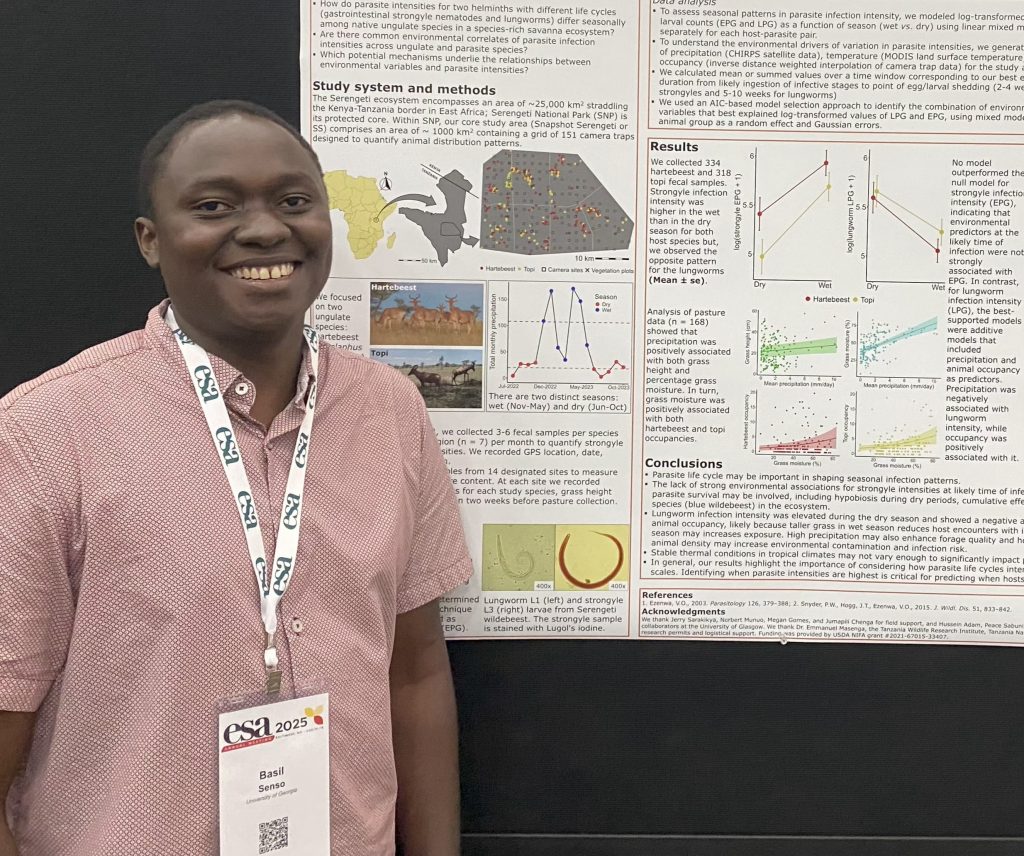
Basil presented his master’s research at the Ecological Society of America’s 110th Annual Meeting, showcasing a poster titled “Environmental Drivers of Parasitic Nematode Dynamics in Wild Ungulates in the Serengeti National Park.” His study investigated how seasonal environmental variables influence infection intensity of two parasitic nematodes, strongyles (with a direct life cycle) and lungworms (with an indirect life cycle) in Coke’s hartebeest and topi. The findings revealed a high prevalence of parasites and distinct seasonal patterns. Strongyle intensity peaked during the wet season, while lungworms were more prevalent in the dry season. These insights shed light on how parasite life cycles interact with environmental factors to shape transmission dynamics in wild ecosystems.