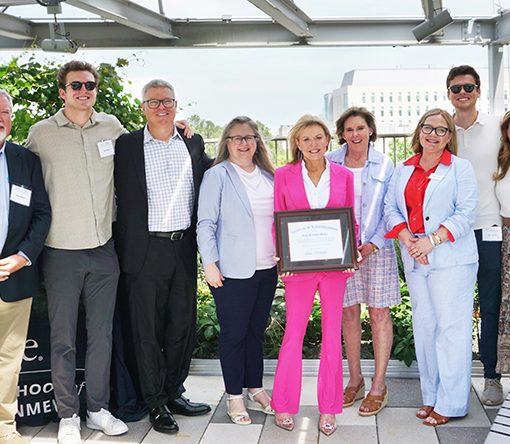

Peter Layton stepped into the role of Chair of the Nicholas School Board of Visitors in July 2026, after 14 years serving on the board. He is one of the founding partners of Blackthorne Capital Management, LLC, and is CEO and owner of the Tallgrass Group, the parent company of various corporations specializing in ecological restoration. He also recently became the CEO and owner of the Global Supply Chain Exchange (GSCX), an initiative to bring lesser developed countries into the international trade ecosystem. He served as chairman of the boards of the securities exchange BOX Holdings and Box Markets for 14 years. He was a partner at both The Hull Group and Goldman Sachs & Co., from which he retired in 2005.
We sat down with Peter to discuss how he chose his current path, why he serves on the board, and what advice he would give to Nicholas School students and alumni.
How did Tallgrass get started and how does it support ecological restoration?
When I got out of college, I worked at a stock execution group on the trading floors of Chicago. You’re basically in pits full of large, angry people. They’re swearing at each other; fights break out. And I said to myself, “I’ve got to get out of here on the weekends.”
I found a little lake house in Wisconsin. And then I thought, “This isn’t quite enough. I need a big patch of land where I can just go walking.” I put an ad in the local newspaper to see if anyone was interested in selling land in the area. At first, people were skeptical. Then about three or four years later, people started coming to me to sell their plots of land, so I started looking into what I could do with them.
That’s when I started reading about land restoration. This was about 25 years ago, and there weren’t companies then that were looking to restore land as a business. I talked to a few people who had pickup trucks and botany degrees, and they were attempting to do it, but they couldn’t do it at scale.
So just like my Wall Street training, I collected them and rolled them up into one bigger company with more capital and ability to do this at scale. And that’s how I started Tallgrass Restoration.
What kind of progress has Tallgrass made since its founding?
We’ve grown a lot. Our clients now include corporate campuses that don’t want to mow Kentucky bluegrass, people who want LEED-certified registration for their buildings, and estate owners, especially in the ravines along Lake Michigan, who want their ravines restored so they don’t erode.
There’s a burgeoning demand for this. At one point I got a call from Madison Audubon [now the Southern Wisconsin Bird Alliance]. They had a program with the state where, if there is a sensitive piece of land and they can find someone to front the money, they can get a grant to buy the development rights from you. I went to an auction of properties facing default or foreclosure in rural Wisconsin, and this one piece of land was on an important migratory bird path. I fronted the money and put a conservation easement on the land, and we opened another Tallgrass office there.
For another piece of property that was between two rivers and prone to flooding, I met with scientists to create a wetland mitigation bank. At that point in time, we were the only wetland mitigation bank in the state of Wisconsin. We worked with the Department of Natural Resources and came up with a proposal to provide wetland credits that you can sell to developers. We have done pollinator credits as well.
What do you see as possibilities in the area of landscape restoration?
There’s really a growing acceptance of the idea that restoration can occur at scale through cooperation and coordination. We’re also seeing a lot of technological improvements. There’s a lot more native seed available, so there are more people cultivating native plants. Herbicides are also getting better and safer.
You recently became CEO and owner of the Global Supply Chain Exchange, which helps lesser developed countries succeed in trade. What inspired you to get involved?
I was helping a mathematician who came up with a solution on how to incorporate two-thirds of countries into international exchange who haven’t been able to participate previously. The reason is that they don’t have access to hard currencies. Basically, they don’t have dollars, pounds, or euros. Say you’re a farmer in India and you want a John Deere tractor. John Deere will say, “Send us this much in dollars.” If you go to your bank and ask for a letter of credit to denominate in dollars, they’ll say it will take six to eight months. As a result, the trade never happens.
This problem is so pervasive, and if you’re in a country that uses dollars, pounds, or euros, you don’t even know it exists. I think roughly $4 trillion in unfunded trade fails every year.
Now we think we can solve this problem. I was chairman of securities exchange for 14 years, so I understand that exchanges need to happen in one ecosystem. If the farmer from India came into our exchange and John Deere was also in our exchange, we’d not only match the import and the export, but we’d also match him with an insurance carrier and a shipper. There’s nothing left hanging. We can de-risk the process.

How did you initially get involved with the Nicholas School?
I was actually escaping a hurricane on the Crystal Coast, and was driving back to Raleigh-Durham to catch a flight home. I checked into the Washington Duke Hotel and had just put my luggage down when I got a call from [former] Dean [Bill] Chameides.
I met up with him and we chatted for a while. He mentioned that they didn’t currently have anyone on the board that ran a for-profit environmental company, and that was a perspective he wanted to add.
We stayed in touch, and a few years later we found ourselves sitting next to each other on a plane. He invited me to attend a board meeting to see if I’d like to join. When I met the members, I was struck by the quality of the people and the work. How could I say no?
What perspective do you bring to the board as a CEO?
I think I’ve helped bring the private sector arm of solutions into the group of solutions that we want to consider or discuss. I think about what free-market solution we should try or incentivize, such as wetland banking. It’s not the only solution, but it’s an arrow in your quiver. And there are other solutions such as regulation. For a very sensitive wetland, for example, you’re not going to get a permit for that. Leave it alone. But both are viable solutions and they both need to be considered within the bigger portfolio of solutions.
Also, I hope I’ve influenced students about the importance of networking and being able to speak the language of business. They’re going to have to convert science into numbers, into balance sheets, into KPIs.
What motivated you to take the role of Board Chair, and what are your goals?
I think the Nicholas School Board is already pursuing so many great directional trends and strategies, that one of my main missions is to keep accelerating and supporting that. These joint degrees [with Fuqua and Divinity] are super important for teaching people different dialects and also strengthening their market capability as graduates.
Second, the technology being developed at the Nicholas School is so impactful, and we need to make sure that it’s brought to market.
Finally, I want to promote cooperation and collaboration. I was recently asked to attend a meeting in New York between the Nicholas School and African Parks [a nonprofit conservation organization that rehabilitates and manages protected areas]. They had started a joint venture where the Nicholas School will monitor and evaluate African Parks’ rewilding efforts to recommend best practices and improve results. That type of cooperation is what I try to support and emulate.
How have you seen the board change over the years?
I’m seeing many more two-way conversations. The board is increasingly asking questions to better understand the issues and put forth constructive recommendations. It’s also doing a better job recruiting and onboarding members who can make the board more effective. In addition, the staff is learning how to better use the board as a resource.
Why do you feel that investing in the Nicholas School is so important?
I support unique thought and thought leaders in everything I do — private sector or public sector. And that’s what Nicholas is. It’s a thought leader and a technology leader. Its voice matters on a global basis, but it also matters a lot on regional and local levels, in areas such as PFAS.
Take this joint venture with African Parks. It shows you how the school is magnifying and multiplying impact because of the science and know-how it’s bringing to the table.
It’s so important that we give back to advance critical thinking that can help solve these complex challenges we face.
What career advice would you give to Nicholas students and alumni today?
Collaboration is so important. We have a wetland group up here that’s all about preserving the wetlands, and we have a lake group that is all about preserving the lakes. And if you had them list their top 100 priorities, they’d probably agree on 97 of them. The problem is they’d rather argue about the other three. They need to find their common goal as early as possible and focus on it in order to be effective.
Also, I’d encourage students and alumni not to be shy about contacting any of us [on the board]. Please find us on LinkedIn. Reach out to us and our connections. Develop your network, nurture your network, and use your network effectively.